


“Mowi Feed R&D not only embraces change, we drive it. Everything we do is focused on making our feeds more robust and futureproof.”
In terms of R&D in Mowi Feed, our objective is to better quantify the nutrient requirements of salmon and to fully exploit the true value of sustainably sourced raw materials. Although the themes interlink, our research is focused on four areas which are: nutrient requirements; raw material optimisation and utilisation; fish health, welfare and quality; and feed technology.
Fundamental Nutrient Requirements
Mowi Feed continues to focus on optimizing phosphorous nutrition for salmon. We have identified ways to reduce phosphorous levels in feed for large salmon without compromising bone health and reaffirmed phosphorous requirements for small fish in freshwater. These efforts not only reduce phosphorous consumption and emissions but also improve fish growth and feed conversion ratios. We continue to work towards increasing nutrient density of salmon feed while decreasing indigestible carbohydrates and superfluous minerals.
Through our activities in the Research Council financed programme, Millennial Salmon, we continue to investigate lipid-energy metabolism and essential fatty acid requirements, with focus on long chain omega-3 PUFAs. This research is crucial for managing the use of omega-3 from fish oil and future sources like algal and GM oil seeds.
Raw material optimisation
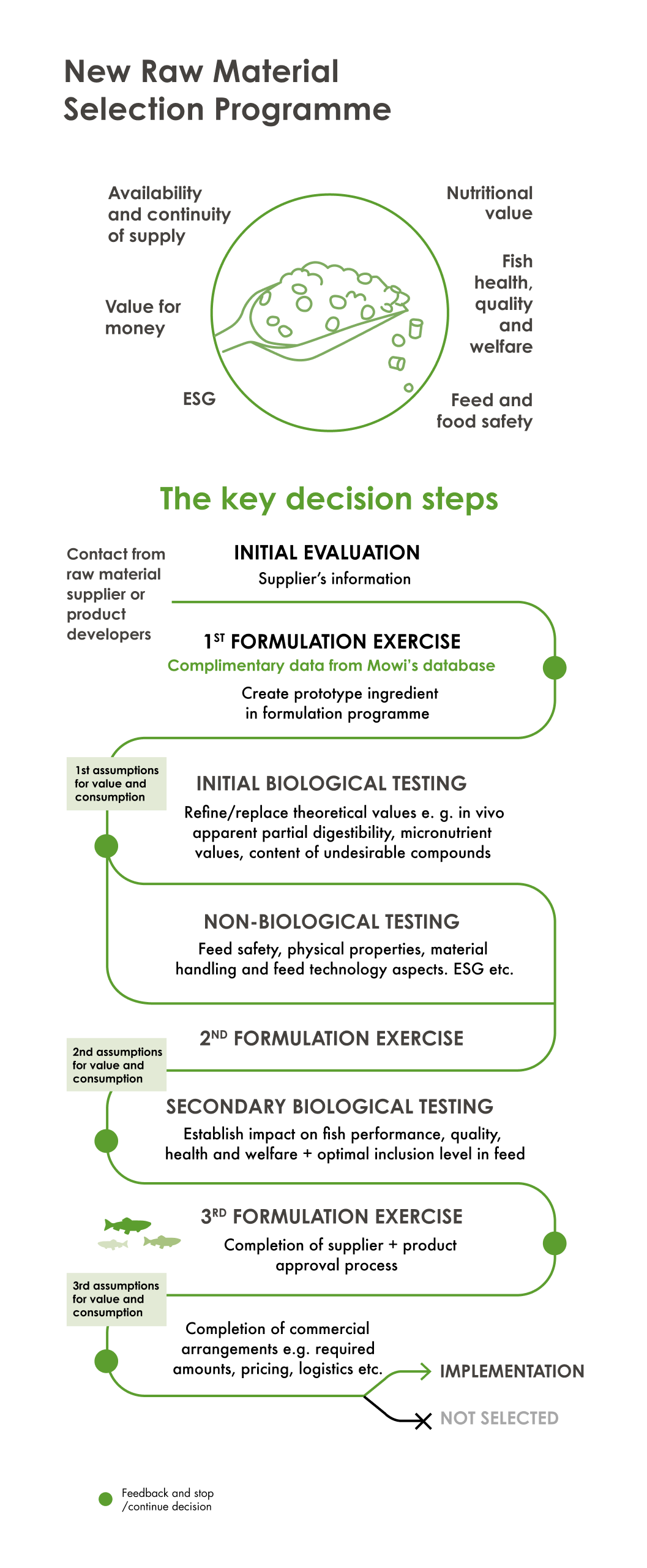
Our long-term goal is to achieve independence from specific raw material sources, ensuring cost competitiveness and flexibility in commodity markets. Fishmeal remains the benchmark feed material due to its digestible protein, balanced amino acids, high-quality lipids, and micronutrients. Despite efforts to reduce dependence on fishmeal, it will continue to play a crucial role in salmon nutrition. We are revisiting our fishmeal quality criteria for both small and large salmon and working with suppliers to meet Mowi’s standards. While we don’t plan to replace fishmeal with marine invertebrates like krill or copepods, we are evaluating these materials for their unique features as more tactical ingredients.
Our search for emerging, non-marine, ingredient sources has shown significant potential in protein concentrates from pulses, legumes, and underexploited cereals. These materials are nearing commercial viability and could compete with soy protein concentrate. The Millennial Salmon project also evaluates oil-rich biomass, algal oil, and insect products as salmon feed ingredients. More details can be found in our policy on emerging feed raw materials on Mowi.com.
Fish health, welfare and quality
Promoting fish resilience through feed is central to Mowi Feed’s strategy. We conducted several projects using functional ingredients like plant extracts and essential oil blends to support salmon exposed to skin and gill damage. Nutritional antioxidants, including vitamins E & C, carotenoids, polyphenols, and selenium, play a crucial role in salmon health and quality. Further research in 2024, supported our new winter health feed strategy and focus on skin and gill repair and robustness against viral cardiomyopathies.
Mowi Feed has focused on developing winter and spring feeds for salmon grown in regions with water temperatures below 6°C. These conditions affect salmon digestion and metabolism, requiring different feed formulations compared to summer and autumn. In 2024, Mowi Feed continued to apply a low temperature-specific digestibility coefficients and updated the specifications for winter health feeds, implemented across Mowi’s operations in Norway, The Faroe Islands, and Iceland.
Feed technology
We continue to optimize feed formulation and feed manufacturing techniques by partial fish oil replacement with algal oils. Organic regulations posed challenges in retaining high fat levels in salmon feeds, but we invested in optimizing feed processes and testing organic-compliant ingredients to stabilize fats without affecting digestibility. Additionally, we developed feeds for closed and semi-closed systems (RAS) to maintain high water quality and nutrient retention.
You can read more about our effort in feed, including our new feed range optimized for closed rearing systems and our updated policy on emerging feed raw materials on Mowi.com/R&D.
Product Development
Winter and spring feeds
An increasing proportion of Mowi’s salmon are grown in regions where winter and spring water temperatures are below 6°C for many months of the year. Particularly in spring, there can be a disconnect between what is happening on land (increasing day length and air temperature) and what the fish experience under the water’s surface (persistent cold temperatures). Under very cold conditions, both salmon digestion and metabolism change markedly and so, feed formulation rules for the winter and spring need to be different to those deployed in the summer and autumn. Understanding these dynamics and extending our database of low temperature-specific digestibility coefficients were central to the deployment of new feed specifications. Furthermore, cold water temperatures, rough weather and low feed intake all represent challenges to maintaining good skin condition in salmon. As part of our review of the seasonal programme for functional feeds, we both raised the specification of our winter health feeds and extended the period over which we recommend them to be fed. These new criteria were implemented throughout Mowi’s operations in Norway, The Faroe Islands and Iceland.
Recirculation / semi-contained production
With ever-increasing focus on smolt production in recirculation units and a drive towards increased salmon size when transferred to sea, there is a requirement to provide feeds that are optimised for use in either closed or semi-closed systems. Maintaining high water quality in closed and semi-closed systems is crucial for their success and feed can play a role in this. Mowi feed has developed methods for assessing feed formulation changes on water quality. The physical properties of the feed (dust, breakage and oil retention), the physical properties of the manure produced and nutrient retention (nutrients in feed minus the amount that is converted into fish) are all factors that Mowi Feed has has optimised. As a result of these efforts Mowi Feed introduced a feed range optimised for use in closed and semi-closed rearing systems.
