You are going to open MOWI Global page

Continue
Home Sustainability Knowledge Why do we need a sustainability strategy?

Why do we need a sustainability strategy?

We have a clear vision: Leading the Blue Revolution. To achieve it, we need a plan that supports our positive and long-term economic and social impact. Leading the Blue Revolution Plan is underpinned by specific commitments to ensure the seafood we produce and sell all over the world takes good care of the fish, the planet and its people.
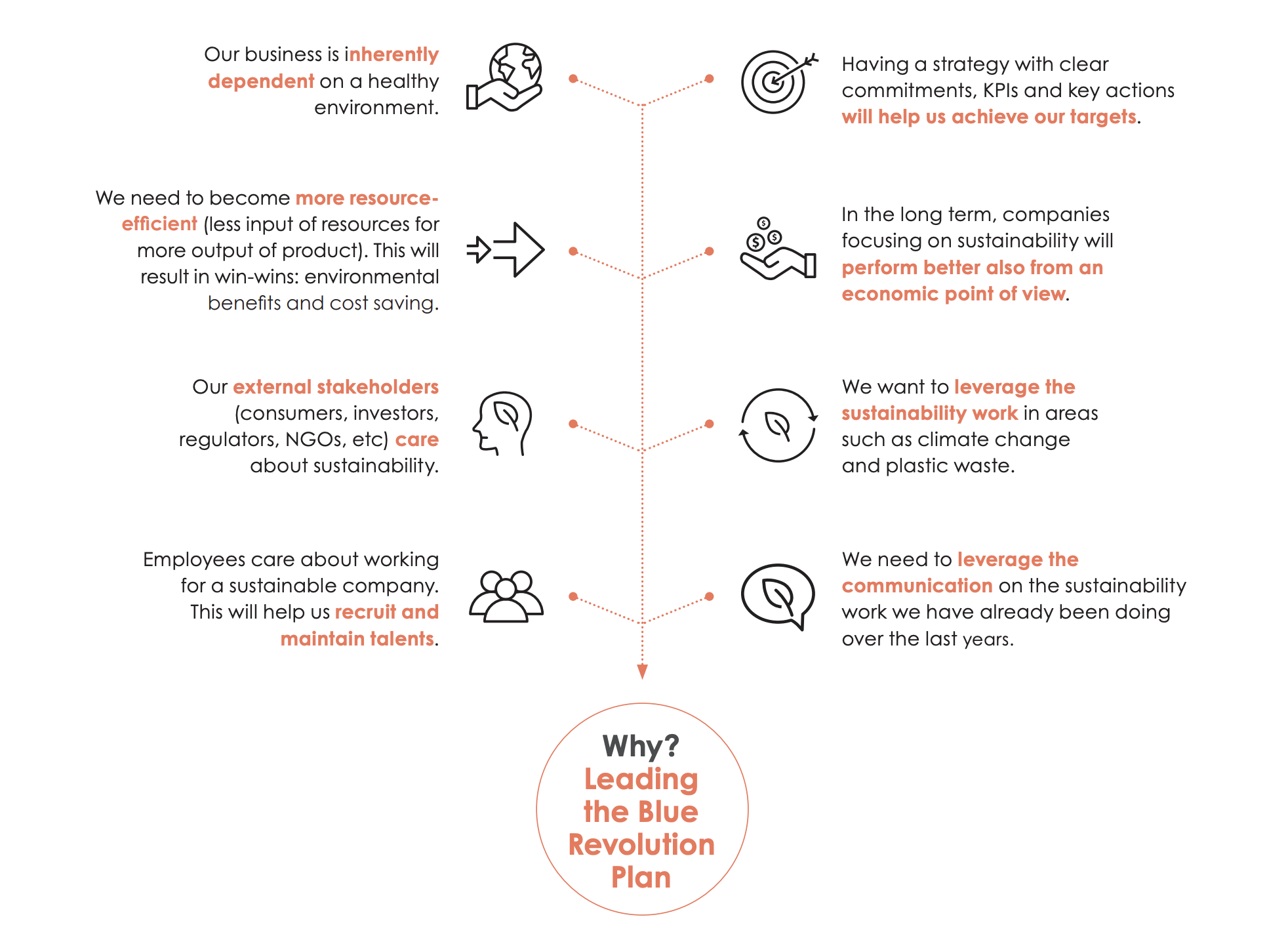
Our business is inherently dependent on a healthy environment.

Having a strategy with clear commitments, KPIs and key actions will help us achieve our targets.

We need to become more resource-efficient (less input of resources for more output of product). This will result in win-wins: environmental benefits and cost saving.

In the long term, companies focusing on sustainability will perform better also from an economic point of view.

Our external stakeholders (consumers, investors, regulators, NGOs, etc) care about sustainability.

We want to leverage the sustainability work in areas such as climate change and plastic waste.

Employees care about working for a sustainable company. This will help us recruit and maintain talents.

We need to leverage the communication on the sustainability work we have already been doing over the last years.

Knowledge

Caring for our fish lies at the heart of what we do, and our primary goal at Mowi is to raise healthy fish and protect their welfare at every stage of the farming process. Our salmon are cared for to industry-leading health and welfare standards by our highly trained farmers, veterinarians and biolo...
Read more
The aquaculture industry has some of the strongest regulations globally, particularly around environmental protection. Mowi adheres to rigorous operations and an ongoing monitoring programme to ensure that the environment is protected and that there are no negative long-term impacts. ...
Read more
At Mowi, we select the strongest, healthiest, and tastiest of each generation to create the finest broodstock. We invest significant efforts and resources to improve the performance, disease resistance, welfare and quality of our fish. ...
Read more
Mowi uses a combination of farming techniques to ensure our salmon have the best start in life. Whether on land or at sea, we raise our salmon using various farming techniques that closely resemble a salmon’s natural life cycle. ...
Read more
The main difference between wild-caught and farm-raised salmon is their environment and diet – wild salmon come from natural oceans and eat items found in the marine ecosystem, while farm-raised salmon are grown in controlled settings and fed a scientifically managed diet – neither of wh...
Read more
Mowi’s sustainable salmon farming practices prioritise minimising environmental impact. Our farms adhere to stringent sustainability certifications to ensure they operate in an environmentally friendly manner. Some of our other efforts include controlling waste, freshwater stewardship, and implement...
Read more
Risk relates to uncertainty and the factors that may prevent us from generating the expected returns, reaching our goals and deliver on our strategy. Through our risk management processes we identify, quantify, and define actions to manage the risks we are facing. We split our defined risks into sub...
Read more
Mowi collects and reports on a large number of sustainability metrics. The table below consolidates our environmental and social data to help with further analysis. ...
Read more
We believe that investments in new knowledge and research will allow for sustainable increase in ocean-based food production. At Mowi, we utilize our full value chain, empowered by new and emerging technologies, to make significant strides to improve our production. Mowi is the only salmon producer ...
Read more
We have a clear vision: Leading the Blue Revolution. To achieve it, we need a plan that supports our positive and long-term economic and social impact. Leading the Blue Revolution Plan is underpinned by specific commitments to ensure the seafood we produce and sell all over the world takes good care...
Read more
Transparency builds trust. Being transparent about our environmental, social and product performance is key for building trust with our stakeholders and correcting misinformation. Our sustainability data is audited by third parties and reported according to global standards such as the Global Report...
Read more
Our vision is to lead the Blue Revolution. Our purpose is to offer a growing population a healthy, tasty and sustainable food. Our strategy is built on a fully integrated value chain. Our guiding principles are profit, product, people, planet and values are passion, change, trust, share. ...
Read more
1. We listen to our stakeholders As a global seafood company, our activities influence a diverse group of stakeholders. At the same time, our stakeholders’ viewpoints and decisions also have an impact of the success of our business. Therefore, ongoing engagement with our key stakeholders is inherent...
Read more